PCOS: Two Key Hormonal Mechanisms Most Women Are Not Told About
PCOS is not just a reproductive condition—it is deeply connected to metabolic and hormonal signaling, especially insulin. Let’s simplify two important mechanisms that drive androgen excess in PCOS 👇
1/15/20261 min read
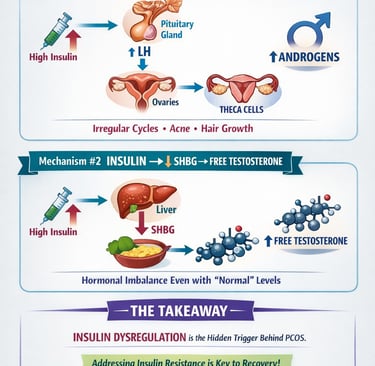
🔹 Mechanism #1: Insulin → LH → Androgen Pathway
Elevated insulin levels stimulate the pituitary gland
This leads to an increase in Luteinizing Hormone (LH)
LH travels to the ovaries and activates theca cells
Theca cells respond by producing excess androgens (male hormones)
📌 Result: Higher androgens → irregular cycles, acne, hair issues, ovulatory dysfunction
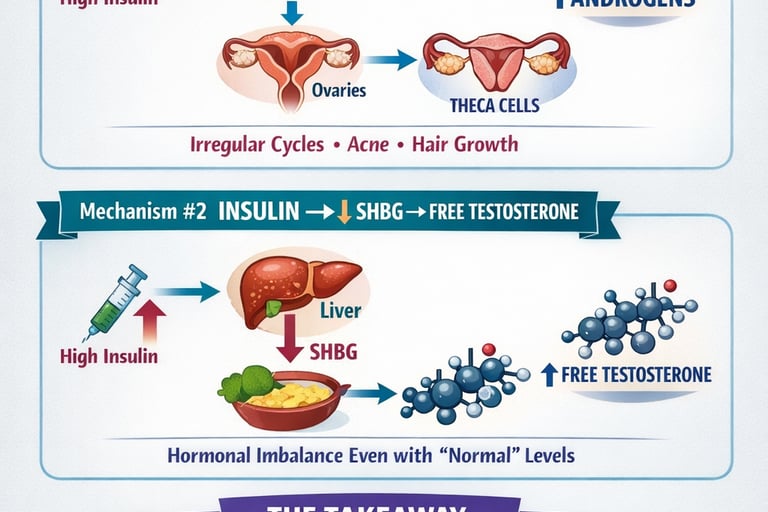
🔹 Mechanism #2: Insulin → Liver → SHBG Reduction
The liver produces SHBG (Sex Hormone Binding Globulin)
SHBG acts as a buffer, keeping androgens inactive
High insulin levels suppress SHBG production
Less SHBG = more free (active) testosterone in circulation
📌 Result: Hormonal imbalance even when total testosterone appears “normal”
PCOS is not caused by “high androgens alone.”
In many women, insulin dysregulation is the upstream trigger that fuels both pathways.
Addressing insulin sensitivity is not optional—it is foundational for long-term PCOS recovery.
My post content
Wellniva
Empowering women through holistic wellness coaching.
Contact
+91 8861686135
© 2025. All rights reserved.
Subscribe